CPT 2011 co-educators attending a Welcoming Braai at Rose's home
Back row: Teddy, Marie, Joe, Siobhan, Katherine, Leanne, Dana,Logan, Kate, Tom, Lianna, Anna, Meaghan, Julian, Taylor
Front row: Ashley, Sharielle, Brenna, Emily, Nicole, Terri, Kayla, Susie
Center front: their new friend Georgia

Human RIghts Training Weekend

Human RIghts Training Weekend
Showing posts with label Sharielle. Show all posts

27 April 2011

Sharielle not wanting to go home


For the past couple of weeks I have been trying to fight the old adage, “All good things must come to an end”. Actually to be honest, I'm still fighting it. I have made so many African friends here, mostly from my church. They have all made me feel welcomed and at home.

It is a sad feeling knowing that you may not see a person ever again. However, I must realize that people will not be in our lives forever. Yes, there will be some people who will be in your life longer than others and others who will be there only for a brief moment. I am coming to realize that it does not matter the amount of time someone is in your life, but what lessons they have taught you within that time.

This gets me to thinking, if these people have made such an impression on me in such a short time, I wonder what impression I leave on others. I do not live in this world in isolation, I come into contact with people everyday. Knowing that we may have an effect on someone's life no matter how briefly we have been it, makes me want to be an even better person.

So while I have not fully wrapped my head around leaving, I know that I have grown as a person. I will be leaving South Africa a better person than when I first came in and I have all my friends to thank for it. I would like to give special mention to the following people: The Staff at Africa Unite, my friends at the Seventh-day Adventist Student Movement (SDASM), Vernon Rose, and all the other Capetonians I had the pleasure of meeting. South Africa had been one of the best experiences in my life and I know that this is not a goodbye, but a see you later because South Africa has a special place in my heart.

15 April 2011

Sharielle's thoughts on Mandla


Mandla, is the name of the little boy from the orphanage that I volunteered at in Khayelitsha for two Sundays. I have searched for words in how to describe him to people, but yet I nothing comes to mind, so here is my best attempt. He is a cute brown skin little boy, with the most precious laugh. He is one of those kids who interacts with all the other little kids, but at the same time is fine by sitting by himself. His eyes are warm and inviting with a tad bit of mischief in them.

I think this is by far the hardest post that I have had to write. I actually have taken a break from writing this blog just thinking about him. Leaving him on Sunday was very hard for me. I think it was a good thing he was eating when I had to leave because I would've probably not been able to stop hugging him. My greatest regret was not bringing my camera. Mandla is the cutest little boy, and the whole time that we played together, I could not stop thinking about what his future will be like. I wanted so bad to take him back with me, but for many reasons this is obviously not possible. This is not a long blog, but I just thought that he deserved a special shout out. I wish more could be done for children like Mandla. I hope that they grow up knowing what amazing people they can be and what they have to offer to our world. 

04 April 2011

Sharielle on Universal Blackness


Universal Blackness. This is a phrase that I thought of one Saturday. As a sociology major, we learn that race is not biological, but a social construction. This explanation helps to discredit stereotypes. However, I believe it is important to look at commonalities.      

I was telling my friends about something that I do in America and one of them said, “See Black people everywhere are the same”. She is not the first person or last that I've heard say that while I have been here in South Africa. For some people they may see this as being a stereotype, but for me I see it as a statement of unity and connection. It was at that moment that I felt closer to my friends.

A lot of times we focus on our differences when we have more similarities. It is amazing how even though we (Blacks) are from different countries, we still have similar cultural traditions and practices. Slavery and colonization caused all Black people to be separated. This separation has made us to forget that there are some practices that we have that are rooted in our African heritage. In my first blog I talked about how emotional and profound the church service in Guguletu was. It was emotional because the same spirit and style of worship was similar, if not the same, as it is in the Caribbean and in some Black American churches. For me it reminded me of how we as Blacks are linked and connected to this continent. I believe that if we remember our past it will help to build a better future.

What I have noticed in the United States in Black communities that there are separations, whether subtle or obvious, among people who are of voluntary migration (people of Caribbean decent and African decent) and those of involuntary migration (Black Americans whose heritage has been in America since the slave trade). We even tend to make distinctions based on skin complexion (ie. darker  vs. lighter). Similar to the issue of xenophobia in South Africa, Blacks tend to be separated and do not work together for their social and economic advancement. I believe that if we focused on our similarities and our cultural traditions that make us unique to other global cultures, we would be able to appreciate the beauty that God gave us. An appreciation and realization of this beauty can mean a better life for all those of African decent. This is a dream that many great leaders like, Nkwame Nkrumah, W.E.B DuBois, Steve Biko, Stokely Carmichael and many others had and a dream I hope to carry out.

30 March 2011

Sharielle on the best spring break ever


Johannesburg, or as I like to call it- Jo'burg, was great! It had a different feel than Cape Town. Jo'burg is essentially the New York of South Africa. Everything was fast paced and tall buildings lined the streets. One thing that caught my eye was the amount of Black people I saw driving nice cars- something that is very hard to find in Cape Town (The majority of people in Jo'burg are Black, in contrast to Cape Town). Even in the lovely hotel we stayed at  there were a lot of successful Black people. For me, it has been a long time, if ever, in which I have been to a place where Black people were the predominantly successful citizens.

Despite, the increase of Blacks I saw in wealthier positions, going to places such as Soweto gave us a reality and a context to the wealth that I saw. The Apartheid Museum, the Hector Pieterson Museum and Sharpeville reminded me of South Africa's dark past. I will not go into detail about everything that I saw, but one of the experiences that really stands out in my mind was walking by the graves of those who died during the Sharpeville Massacre in 1976. Over 60 people were murdered by the police for burning their pass books in resistance to the apartheid government. While walking pass the graves I took a look at the ages of the people who died. A lot of these people were around my age, 21. I kept thinking that these people stood for something. I have to ask myself- “What am I ready to die for?” What is that important to me? While I do have some answers, it is a question that I try to think about daily. These questions serve to motivate me and keep my passion going when I get discouraged.

Now to turn our attention to animals. Kruger National Park (KNP) is located in the province of Mpuma-Langa and the park itself is the size of Israel. I am not an animal or outdoorsy person. However, I do like to observe nature. Thankfully, there were caravans that we rode in- once at sunset and once at sunrise. Everything around me was absolutely breathtaking, from the small chameleon in the tree to the lion that confidently and with ease strolled pass our caravan. 

The sunset and sunrise proved to really make the experience. I have always been in love with just standing outside and watching the sunset, sunrise and stars, this was made all the better by having animals compliment the scenery. This experience, combined with my previous trip to Rwanda, further convinced me that there is no continent or place that is more beautiful than Africa.

On the second day most people went on a game walk through the fields to see animals. I chose not to go along since I am not a fan of walking among animals who can run faster than me. Choosing not to go on this game walk did not mean that I missed out on the awesome things that the park had to offer. Just sitting on the deck, little monkeys were leaping around eating food off of plates. They were just too cute, and seemed to have such an interesting life. I would watch as they would stop in pairs and clean each others fur, hug each other and even fight. It was such a cool experience.

Jo'burg, was by far the best Spring Break I ever had. I was so fortunate to have the opportunity to go on this trip. This trip just further emphasized how much I love South Africa- both the people and animals!

23 March 2011

Sharielle believing in social mobilization for empowerment


Sharielle & Zoe Nkongolo,  Africa Unite
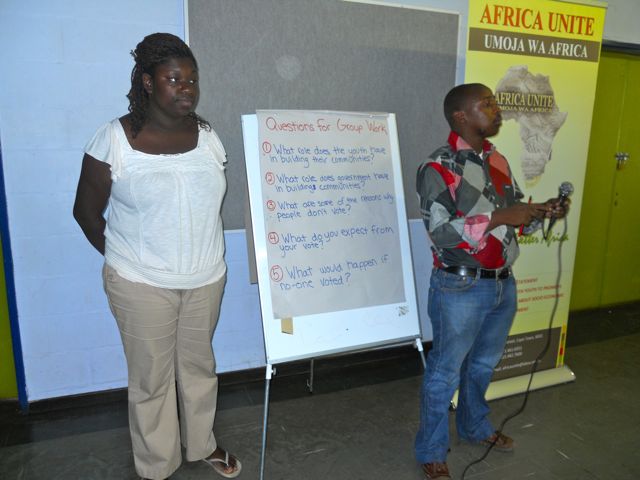
On March 11, for my job at Africa Unite, I planned and attended a youth dialogue in a secondary school in Kraaifontein, about the importance of voting. South Africa is facing a problem in which a lot of the young people are not voting. This reminds me of the United States, especially within the Black community. The most inspiring part of this dialogue was the youth. They eloquently voiced the problems within their community. At such a young age they showed that they could be promising leaders. I believe that a lot of students have the ability to be promising leaders, all they need is empowerment. A lot of potential, I believe, goes wasted because there is no one there to foster and encourage such potential. All the students need to know is that they have power and that what they have to say can help to change their community. Another great thing about this dialogue was that it provided somewhat of a support system for the youth. It showed the youth that they are not the only young people who care about their community. I know from personal experiences that sometimes people do not stand up for what they believe in because they think they will be looked at differently by their peers. This dialogue served to show the students that if they ever wanted to get working in their community, there are other like-minded people as well who would be willing to help.

I hope that I will be able to hold these dialogues within my community. I can fully understand why people do not vote. For years in the United States, we as Black people and minorities have been promised a change and for years nothing has happened. We have had to sit back and watch our communities get worse, our young men die and our women struggle to raise their children. For me, I believe in a community approach to these problems. I believe in a social mobilization that will empower people to see themselves as having something to contribute to their community. Hopefully when we do this our plight will be taken seriously and we can say that we helped to change our community.

12 March 2011

Sharielle believing in social mobilization for empowerment

On March 11, for my job at Africa Unite, I planned and attended a youth dialogue in a secondary school in Kraaifontein, about the importance of voting. South Africa is facing a problem in which a lot of the young people are not voting. This reminds me of the United States, especially within the Black community. The most inspiring part of this dialogue was the youth. They eloquently voiced the problems within their community. At such a young age they showed that they could be promising leaders. I believe that a lot of students have the ability to be promising leaders, all they need is empowerment. A lot of potential, I believe, goes wasted because there is no one there to foster and encourage such potential. All the students need to know is that they have power and that what they have to say can help to change their community. Another great thing about this dialogue was that it provided somewhat of a support system for the youth. It showed the youth that they are not the only young people who care about their community. I know from personal experiences that sometimes people do not stand up for what they believe in because they think they will be looked at differently by their peers. This dialogue served to show the students that if they ever wanted to get working in their community, there are other like-minded people as well who would be willing to help.

I hope that I will be able to hold these dialogues within my community. I can fully understand why people do not vote. For years in the United States, we as Black people and minorities have been promised a change and for years nothing has happened. We have had to sit back and watch our communities get worse, our young men die and our women struggle to raise their children. For me, I believe in a community approach to these problems. I believe in a social mobilization that will empower people to see themselves as having something to contribute to their community. Hopefully when we do this our plight will be taken seriously and we can say that we helped to change our community.

Sharielle hoping to bring home what she is learning and admiring here


Amanda, Ashley, Sharielle
I learned a lot at the Human Rights Training Weekend that my internship, Africa Unite, put on. During this weekend there were 24 youth participants from: South Africa, Zimbabwe, Namibia, Somalia and Democratic Republic of Congo. We were all there, at a beautiful farm, to be trained on being Human Rights Peer Educators. A Human Rights Peer Educator, is someone who goes into their community and hold workshops, informing people on human rights and how it relates to their lives. The goal is to start a snowball effect where people affect change within their community through knowledge and action. In order to start the process of being Peer Educators, we were taught at this weekend about basic human rights, respect of other people, and how different perspectives play into how people view human rights.

One aspect that impacted me the most was the level of commitment that the South Africans and foreign nationals had. Seeing this level of commitment was hopeful especially as someone who is interested in community development. It is easy for us to see a problem in another country and help, however, I believe it is just as important to work with the social problems that plague our own countries. Their motivation is contagious and I am ready to go back to America and work in my own community. However, I do have trepidation about doing this. For me, I have really enjoyed my time at Africa Unite. I have enjoyed the working style and my supervisors. As I mentioned in a previous post, there is no sense of hierarchy or condescending attitude from anyone. I am scared that once I go back to America I will not have an experience or work dynamic like this.

Another thing that I saw at the Human Rights Weekend that I will miss is the spirit of South Africans. It reminded me of the Sunday that we went to the baptist church in Guguletu. Before we would start a session people would break out into singing (mostly Christian songs) and dance. I could not help but think that if we were in America that this would ever happen in a human rights forum or public meeting. However, here it was quite alright. I later found out that it was normal at the beginning of meetings in South Africa to start with singing. Of course since this was South Africa, the singing also meant that there would be some sort of movement involved. It was a contagious rhythm that would get everyone moving. It was hard to stand there and not move, no matter if you're as shy as I am when it comes to dancing. I was once again reminded as to how singing was a bond that tied a lot of people in the community together- in both South Africa during Apartheid and in the United States during the Civil Rights Movement. It was nice to have this cultural exchange were we all shared different aspects of where we were from. I hope to have experiences like this when I come home, because America has so much to offer in terms of diversity.

18 February 2011

Sharielle reaching beyond her comfort zone

Lion's Head
Back Row: Logan, Taylor, Julian, Tom, Joe, Brenna, Leanne, Susie, Katherine, Kayle, Terrie, Kate
Front Row: Anna, Sharielle, Dana, Emily, Nicole, Siobhan, Lianna, Meaghan

I climbed a mountain. This is something that I never thought I would do. I thought that I was going to go for a simple hike, but when I got mid-way, I knew that is was more that just a hike. I wanted to turn back so bad, three times to be exact. It was probably the scariest thing that I ever did. There were times that the path was narrow and all I could see was how far down the real world was. However, when I got to the top, with the help of Brenna and Meaghan, it was worth it. The view from Lion's Head, was absolutely GORGEOUS! I did not know where to look. On one side there was the beach, the other Table Mountain was facing us and on the other side was the city lit up. If I knew how the trail was before I went there, I don't think I would've gone. I am grateful for the experience, because it was something that I never would've done and probably will not do again.
           
I am hoping that this is just one of the experiences in South Africa that I have that will help me get out of my comfort zone. Getting out of my comfort zone does not necessarily mean that I have to climb a mountain, but put my places in situations that I normally would not. These situations that let us become a better person and taking on new perspectives. I cannot wait to see what else South Africa has to challenge me with! 
Brenna, Sharielle, Meaghan

08 February 2011

Sharielle's feeling at home with her internship

The first week of my internship has been great! I was so anxious for weeks to see where Vernon, the internship coordinator and our loveable Capetonian tour guide, placed me. When I was asked in my pre-trip interview where I wanted to be placed, I had no idea. My social interests were all over the place. I did not know how to balance all my interests and properly verbalize how I wanted to advance the Black South African population. As a friend of my mine once said, “I am quite promiscuous when it comes to my human rights interests”. However, Vernon did a wonderful job of placing me at an internship that not only allowed me to work with social cohesion, but I already feel at home with my internship. Absent from Africa Unite, is a sense of hierarchy. There are clear-cut roles for everybody in the office, however titles are not important. I feel that in most of the places that I have worked in America, there is always a fear of the supervisor. At Africa Unite I feel like I am apart of the team. Even though I was only there for two days my supervisors were welcoming of all my comments and suggestions. I did not feel intimidated or scared to contribute or ask questions. From the newest of interns to the most senior of supervisors, we are all partners in helping to improve social cohesion.

What I admire most about my internship is the method they use to help solve the issues of xenophobia towards immigrants and refugees. It seems that most organizations ask for donations for people's physical needs. While monetary donations are very necessary, so are social programs. The programs that are done at Africa Unite promote social cohesion by allowing the youth to take on leadership roles promoting human rights. Other programs also cater to helping young people get the skills that they need to be employable. All these programs are important in helping with the issue of xenophobia towards other African immigrants. One of the reasons why xenophobia is prevalent towards immigrants is because South Africa has an unemployment rate of 40% and some feel that foreign nationals are taking away jobs.

I am hopeful that within the next two months I will learn a lot from my internship about how to make social cohesion possible.

25 January 2011

Sharielle gaining a sense of optimism


Sharielle and friends
Cape Town has easily become one of my favorite cities. Many times the images of Africa that come across American media are one of helplessness and despair. However, on first glance when someone walks around Cape Town, the images of Africa once seen on the evening news disappear and are replaced with images of European architecture and “sophistication”.

In spite of that, the beauty of South Africa does not lie in its European architecture, but in the soul and spirit of its people. The embodiment of this sprit was fully captured for me on Sunday, 23 January 2011, when we went to Sivuyile Baptist Church in Guguletu, a predominately Black township. It was in this church that people who came from the poorest communities could have an arena to just be. It was a moment of escape where their burdens could be placed at the altar and the walls of the church served as a form of solace. The pastor's words were robust with hope and promise of God's faithfulness and at any moment the expression of one could ignite song from another. Hearing the melodious harmony that escaped the mouths of the congregation, there rang out much more than musical notes. Behind their harmonies, was pain and hope all mixed into one. I could only wonder how the beauty of music and community fellowship helped South Africa overcome apartheid.

This form of call and response gave me a sense of optimism for South Africa. If this same spirit of community could transcend the walls of the church and permeate through townships, real social change could occur. This experience reinforced to me that the progression and development of a country should not be determined by the amount of Western buildings they erect, but by the communal ties that exist. For it is these community ties that further emphasize the value of ubuntu- I am because we are.

24 October 2010

Sharielle: Looking for parallels and lessons

Before knowing about my acceptance I already had a strong bond to South Africa and its people; it just felt right. Ever since going to Rwanda December 2009, I have been dying to go back to Africa to work in collaboration with the people of different African countries. I can be indecisive, but something about this program just felt right. I was very excited to get accepted into the program; it was so surreal that I was going to be able to have this experience. I felt this way because I was going to be able to have the experience that I believe would contribute to my success in the future as a social worker and community activist. 

I anticipate to form solidarity with the people of South Africa. As an Afro-Caribbean-American, I have a sense of connection to my African roots. I have been more and more interested in being able to connect with the people in South Africa. I feel that especially since South Africa went through apartheid and so did America there is a lot parallels and lessons to learn. Working with alleviating the effects of institutionalized racism is my plan in the future and I believe that South Africa will equip me with the skills I need to do so. I know it will give me strategies to use to work with marginalized groups of people and claiming their rights. Besides that I am excited to see how I change as a person and how my perspectives change as well. Hopefully, this experience would make me a more critical thinker in how to solve different situations.